Wellington beneath the surface
Discover the hidden ecosystems on your doorstep
Wellington’s coastline is home to remarkable marine ecosystems, often referred to as Wellington’s Blue Belt, including kelp forests, reefs, and sponge gardens that support rich coastal biodiversity. While these ecosystems shape the health of our coast, much of this world remains hidden below the surface, and changes go unseen and often unnoticed.
Explore Your Coast helps make Wellington’s marine ecosystems visible, building understanding of why they matter and how they are changing, and contributing to knowledge, observations and decisions that support long-term recovery.
The 70km Dive
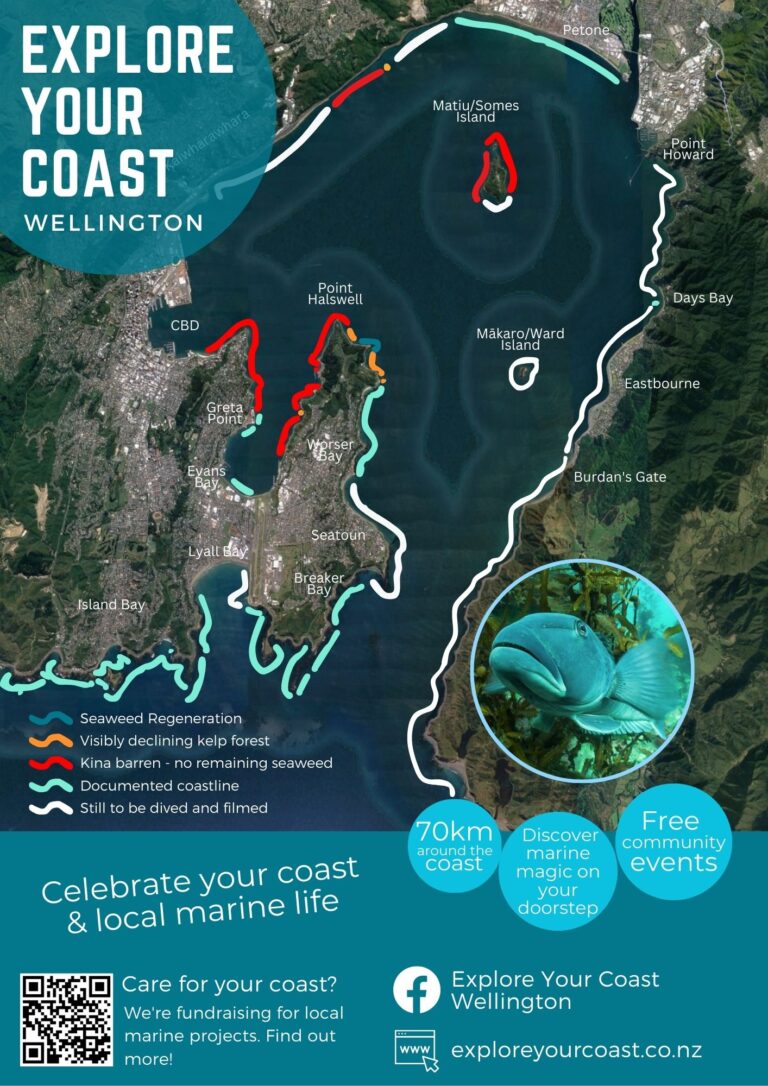
The 70 km Dive is a longer-term project documenting Wellington’s South Coast and Harbour, documenting underwater environments that are rarely seen from the surface. Through diving, photography, film, and public events, we bring these underwater environments to life, revealing the diverse range of habitats that shape this coastline.
To date, more than 52 km of coastline has been documented (over 41 hours of video), creating an extensive visual record of Wellington’s marine ecosystems and supporting a deeper understanding of how they are changing over time.
The remaining coastline presents a significant logistical challenge and requires a coordinated team effort across divers and volunteers. You can learn more about the project and our work in a feature on TVNZ’s Seven Sharp (link to video).
Wellington's Kelp Forests
Kelp forests are one of Wellington’s most important coastal ecosystems, providing habitat, food, and shelter for hundreds of marine species, supporting biodiversity, fisheries, recreation, and coastal resilience. We have lost significant areas of kelp forest in Wellington Harbour without widespread awareness of the change.
Through ongoing monitoring and community engagement we are helping build a clearer picture of how these ecosystems are changing and what supports their recovery.
Restoration in Action
Data collected by volunteer divers and citizen scientists, supported and coordinated through Explore Your Coast, has helped inform a kelp forest restoration and kina management project at the northern tip of the Miramar Peninsula (more info on kinaowhanganuiotara.nz). Volunteers continue to contribute before-and-after monitoring and, within recreational catch limits, help manage kina abundance in the project area.
This work highlights an important ecological pattern: where kina grazing pressure is sufficiently reduced, kelp forests can begin to recover and regrow across previously barren reef.
At the same time, it demonstrates the limits of manual intervention. While kina removal can support local recovery, it is not scalable across the full coastline. Kina continue to recruit to reefs, and individuals can move back into cleared areas from surrounding habitats. Long-term kelp forest restoration at the scale of Wellington Harbour requires functional populations of natural kina predators to help maintain a balance within the reef ecosystem.
Developing Citizen Science Methods and Innovative Tools
Explore Your Coast combines novel marine citizen science methods with innovative monitoring tools to better understand and protect local underwater forests and marine habitats. Volunteers help track the health of coastal ecosystems by monitoring giant kelp and contributing to kina surveys and kina counts, alongside video transects, remote camera monitoring and other established and emerging methods.
By collecting and sharing local data, we contribute to research, restoration, community stewardship, and better informed decisions about our coastal marine ecosystems.
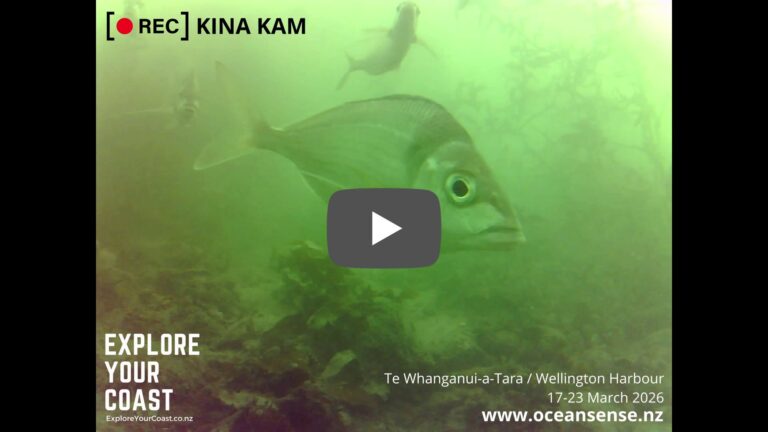
Using the Oceansense KinaKam to capture time-lapse footage of marine life in Wellington’s kelp forests (link). Check out more KinaKam footage here.
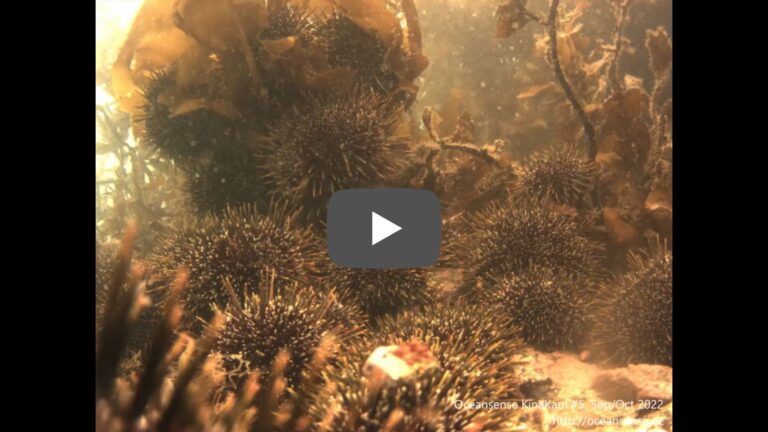
Using the Oceansense KinaKam to capture kina grazing (link) and kina barren formation. Check out more KinaKam footage here.
Supporting Our Work
The 70 km Dive and associated monitoring programmes rely on a combination of volunteer effort, project coordination, technical equipment, and sustained financial support. Continued progress depends on building long-term partnerships and securing funding to maintain fieldwork, data collection, and public engagement activities.
Take part in the change
There are many ways to engage with and support Explore Your Coast:
- Join one of our events and take part in community-led action to document, monitor, and restore local marine environments
- Partner with us to support long-term impact and ongoing fieldwork
- Become a donor or supporter to help sustain the equipment, data collection, and public engagement that make this work possible
- Not sure where to start? We can help design pathways for schools, groups, and organisations to engage in local ocean action.
Get in touch to find out more.
Made possible by our donors and supporters
- Royal Port Nicolson Yacht Club
- Oceansense
- Haku Marine Ltd
- Kinanomics by EnviroStrat
- HAL Consulting Ltd
- Digital Cactus
- Mantis Subs
- Dive HQ Wellington
- Dive Wellington
- Friends of Taputeranga Marine Reserve Trust
- Project Baseline Wellington
- Underwater Biodiversity
- The Warehouse Lyall Bay
- TS Marine Services
- Gordon Harris Art
- Tidal Zone
- Karori Auto Services
- Move Massage & Bodywork
- Cheryl Godkin
- Helen Rodenburg
- Victoria Quade
- Bruce Harvey
- Ingrid van Elst
- Chris Nipper
Explore Your Coast dives documenting Wellington’s Coast are part of the UN Ocean Decade events.